

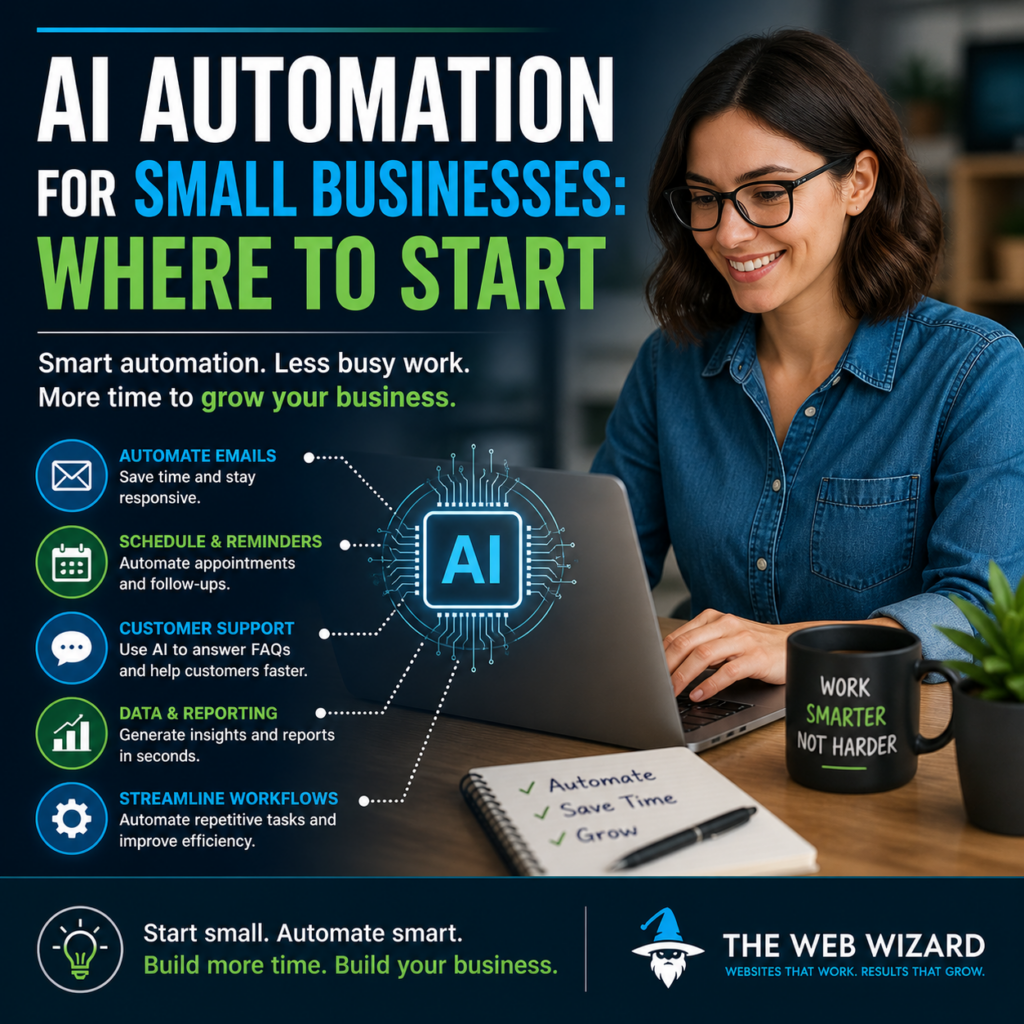
Why AI Automation Matters for Small Businesses
For many small businesses, time is the most limited resource. Owners and teams often juggle multiple roles, handling everything from customer service to marketing and operations.
AI automation is quickly becoming one of the most effective ways to reduce workload while improving efficiency.
Instead of manually handling repetitive tasks, businesses can use AI tools to automate processes, organize data, and streamline workflows. This allows teams to focus more on growth, customer relationships, and higher-value work.
The key is knowing where to start.
Start by Identifying Repetitive Tasks
The best place to begin with AI automation is by looking at tasks that are repeated daily or weekly.
These often include:
- Responding to common customer inquiries
- Scheduling appointments or sending reminders
- Updating spreadsheets or organizing data
- Posting on social media
- Creating reports
If a task is repetitive and time-consuming, it’s a strong candidate for automation.
By identifying these areas first, small businesses can implement AI solutions that provide immediate value without disrupting core operations.
Focus on Simple, Practical AI Tools First
One of the biggest mistakes businesses make is trying to implement complex AI systems too quickly.
Instead, start with simple, practical tools that solve specific problems.
For example:
- Automating email responses or follow-ups
- Using AI to generate reports from structured data
- Creating templates for recurring tasks
- Streamlining internal workflows
These types of solutions are easier to implement and can deliver quick wins, helping your team build confidence in using AI.
Improve Workflow Efficiency Across Your Business
AI automation is not just about saving time—it’s about improving how your business operates.
By streamlining workflows, you can:
- Reduce human error
- Improve consistency
- Increase productivity
- Speed up internal processes
For example, instead of manually compiling data from multiple sources, AI tools can organize and present that information automatically.
Over time, these improvements create smoother operations and better overall performance.
Support Your Team, Don’t Replace Them
A common concern about AI is that it replaces jobs. In reality, for small businesses, AI works best as a support tool.
AI helps by:
- Reducing repetitive work
- Assisting with data processing
- Providing faster insights
- Supporting decision-making
This allows your team to focus on higher-value tasks like customer relationships, strategy, and business development.
The goal is to enhance productivity—not replace people.
Train Your Team for Better Adoption
Even the best AI tools won’t deliver results if your team doesn’t use them properly.
That’s why training and support are essential.
Start by:
- Providing simple instructions or quick-start guides
- Offering short training sessions
- Encouraging feedback from team members
- Gradually introducing new tools
When employees understand how AI helps them, adoption becomes much easier and more effective.
Track Results and Improve Over Time
AI automation should be treated as an ongoing process, not a one-time setup.
Track key outcomes such as:
- Time saved
- Task completion speed
- Accuracy improvements
- Workflow efficiency
By monitoring these results, you can refine your processes and continue improving how AI is used in your business.
Small adjustments over time can lead to significant long-term gains.
Keep AI Use Responsible and Secure
As with any technology, it’s important to use AI responsibly.
Small businesses should ensure:
- Sensitive data is protected
- AI outputs are reviewed when necessary
- Processes are transparent and controlled
A responsible approach ensures that AI remains a safe and effective tool for business growth.
Getting Started with AI Automation
AI automation doesn’t need to be overwhelming. Starting small and focusing on practical improvements can deliver immediate benefits.
Whether it’s automating repetitive tasks, improving workflows, or supporting your team, AI can help small businesses operate more efficiently and scale more effectively.
For businesses ready to take the next step, working with professionals who understand both technology and business processes can make implementation faster and more successful.