

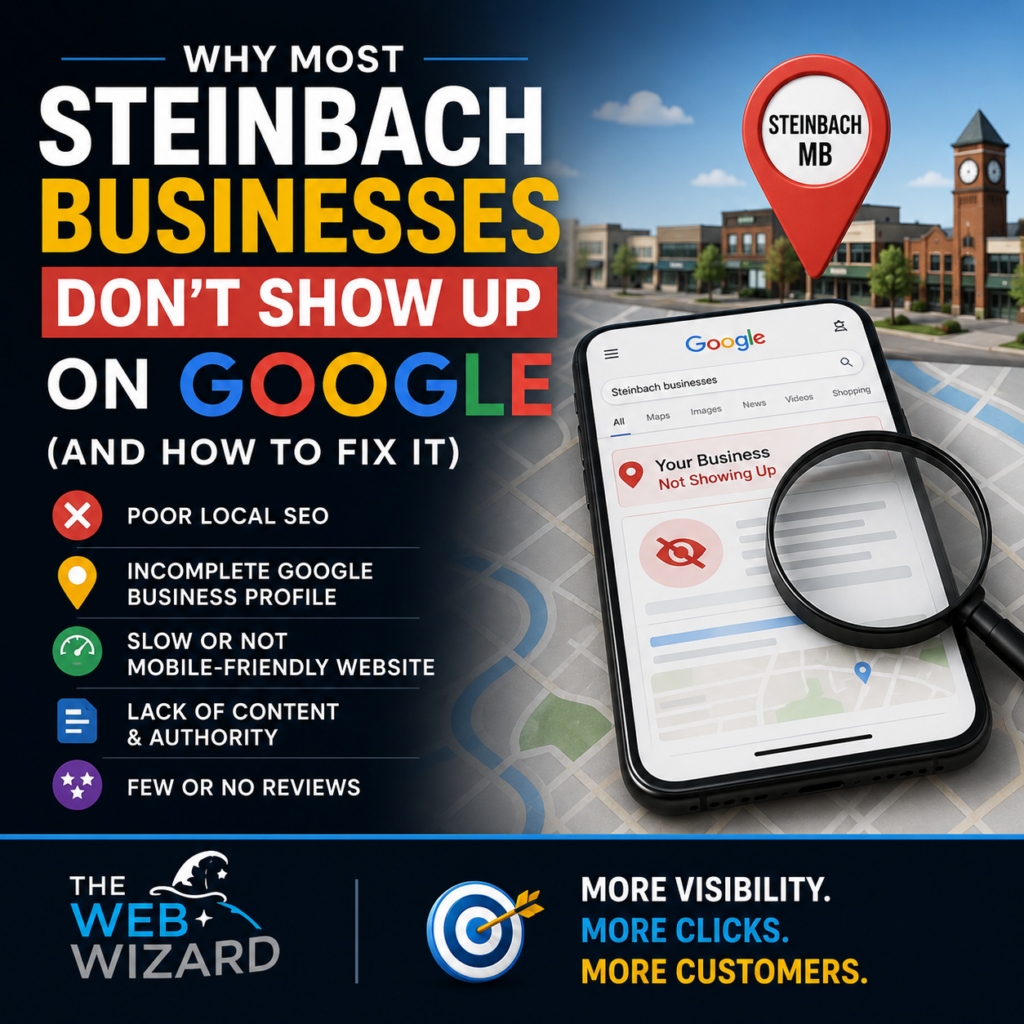
If you’ve ever searched for your business on Google and wondered why competitors appear before you, you’re not alone.
Many businesses in Steinbach struggle to rank in local search results, even when they offer excellent products or services. The truth is, simply having a website is no longer enough. Google now prioritizes businesses that are optimized properly for local search, user experience, and trust.
The good news? Most visibility problems can be fixed.
Here’s why many Steinbach businesses don’t show up on Google—and what you can do about it.
1. Your Website Isn’t Optimized for Local SEO
One of the biggest reasons businesses fail to rank is because their website doesn’t clearly tell Google where they operate.
If your pages only mention general services without referencing Steinbach or surrounding communities, Google has a harder time connecting your business to local searches.
For example, there’s a major difference between:
- “Professional web design services”
and - “Professional web design services in Steinbach”
Location-based keywords help Google understand who your business serves.
To improve local SEO:
- Include “Steinbach” naturally throughout your website
- Add location-specific service pages
- Optimize page titles and headings
- Include your city in image alt text and meta descriptions
These small changes can significantly improve local rankings over time.
2. Your Google Business Profile Is Incomplete
Your Google Business Profile is one of the most important tools for local visibility.
Businesses with incomplete profiles often struggle to appear in:
- Google Maps
- Local search results
- “Near me” searches
A properly optimized profile should include:
- Accurate business information
- Updated hours
- Services
- Photos
- Reviews
- Regular posts and updates
Many businesses create a profile and then forget about it. Google rewards active profiles because they signal legitimacy and trust.
3. Your Website Loads Too Slowly
Speed matters more than ever.
If your website takes too long to load, visitors leave quickly—and Google notices. Slow websites often rank lower because they create a poor user experience.
Common causes of slow websites include:
- Oversized images
- Outdated hosting
- Too many unnecessary plugins
- Poor website coding
A fast website not only improves rankings, but also increases conversions and customer trust.
4. Your Website Isn’t Mobile Friendly
Most local searches now happen on mobile devices.
If your website is difficult to navigate on a phone, users will leave almost immediately. Google also prioritizes mobile-friendly websites in search rankings.
A mobile-optimized website should have:
- Easy-to-read text
- Fast loading speeds
- Clickable buttons
- Simple navigation
- Responsive design that adjusts to all screen sizes
If customers struggle to use your website on mobile, Google assumes it isn’t providing a good experience.
5. You Don’t Have Enough Content
Many businesses launch a website with only a few pages and never update it again.
Fresh content helps Google understand:
- What your business does
- What services you offer
- Which areas you serve
- Whether your website is active and relevant
Blog posts are especially powerful for local SEO.
Topics like:
- “Best website practices for Steinbach businesses”
- “Why local SEO matters in Steinbach”
- “How businesses can improve online visibility”
can help attract local traffic while building authority in your industry.
6. Your Competitors Are Simply Doing More SEO
Sometimes the issue isn’t that your business is doing something wrong—it’s that competitors are investing more into SEO consistently.
Businesses that rank well on Google are usually:
- Adding content regularly
- Building backlinks
- Optimizing pages
- Collecting reviews
- Improving website performance over time
SEO is not a one-time task. It’s an ongoing strategy.
The businesses that consistently invest in their online presence are usually the ones that dominate local search results.
7. You’re Missing Trust Signals
Google wants to recommend trustworthy businesses.
Trust signals include:
- Positive Google reviews
- Testimonials
- Secure HTTPS websites
- Professional branding
- Accurate contact information
- Consistent business listings online
If Google sees incomplete or inconsistent information across the web, it may reduce your visibility.
Trust matters not only for rankings, but also for converting visitors into customers.
Final Thoughts
If your Steinbach business isn’t showing up on Google, it doesn’t necessarily mean your business isn’t good—it usually means your online presence needs improvement.
The good news is that local SEO is one of the most effective long-term marketing strategies available. By improving your website, optimizing your Google Business Profile, creating useful content, and focusing on user experience, you can dramatically increase your visibility online.
The businesses that invest in SEO today are the ones that will continue attracting customers tomorrow.